JobTracker
Role / Services
Design & full-stack development
Context
Personal project
Location & year
Hungary ©
2026
Overview
Your whole job search, organized in one place.
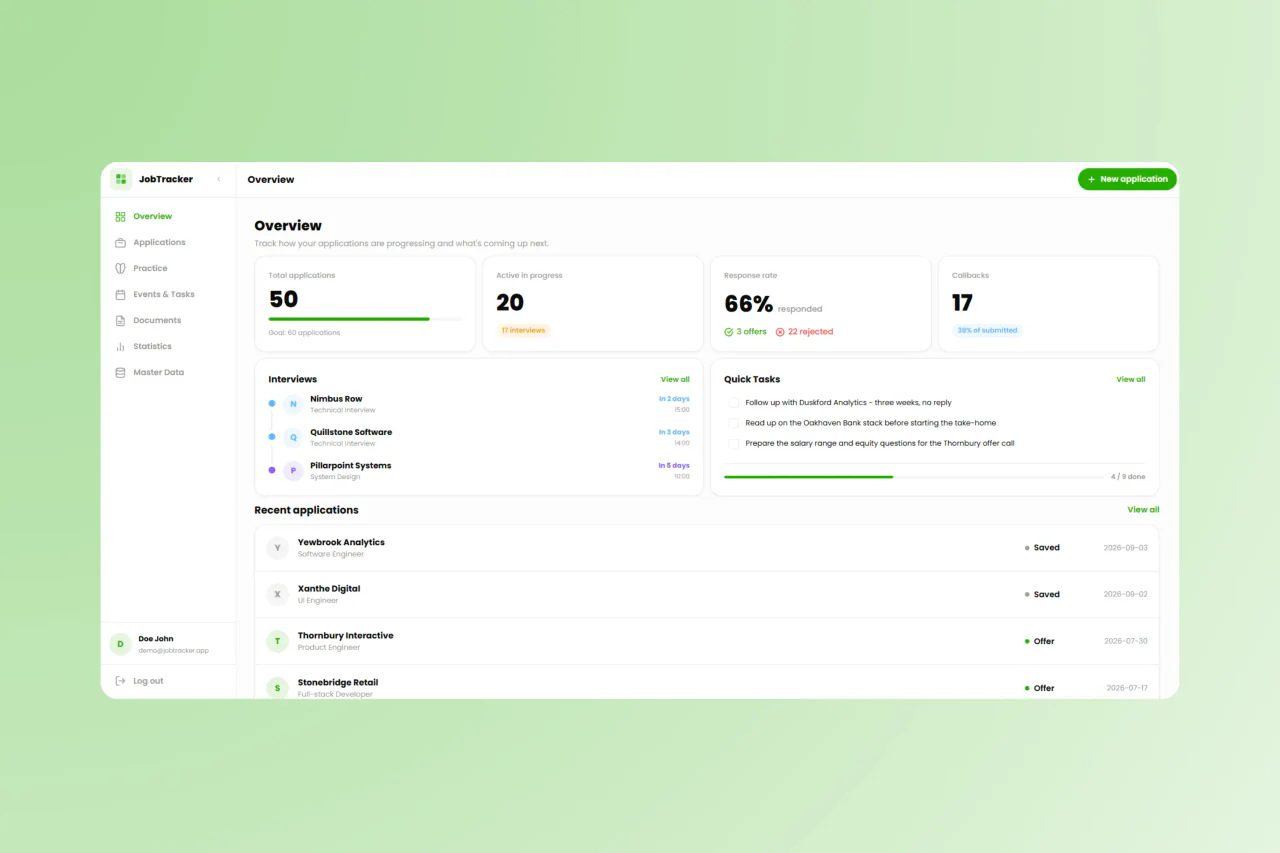
JobTracker is a full-stack platform that gives candidates a structured, central view of their hiring pipeline. It records every stage of each application, keeps the related documents together, and helps candidates prepare for interviews with AI-evaluated practice sessions.
It replaces the spreadsheets, notes and browser tabs a job search usually spreads across, where deadlines and follow-ups are easy to lose and interview preparation is hard to assess.
Key features
Application pipeline
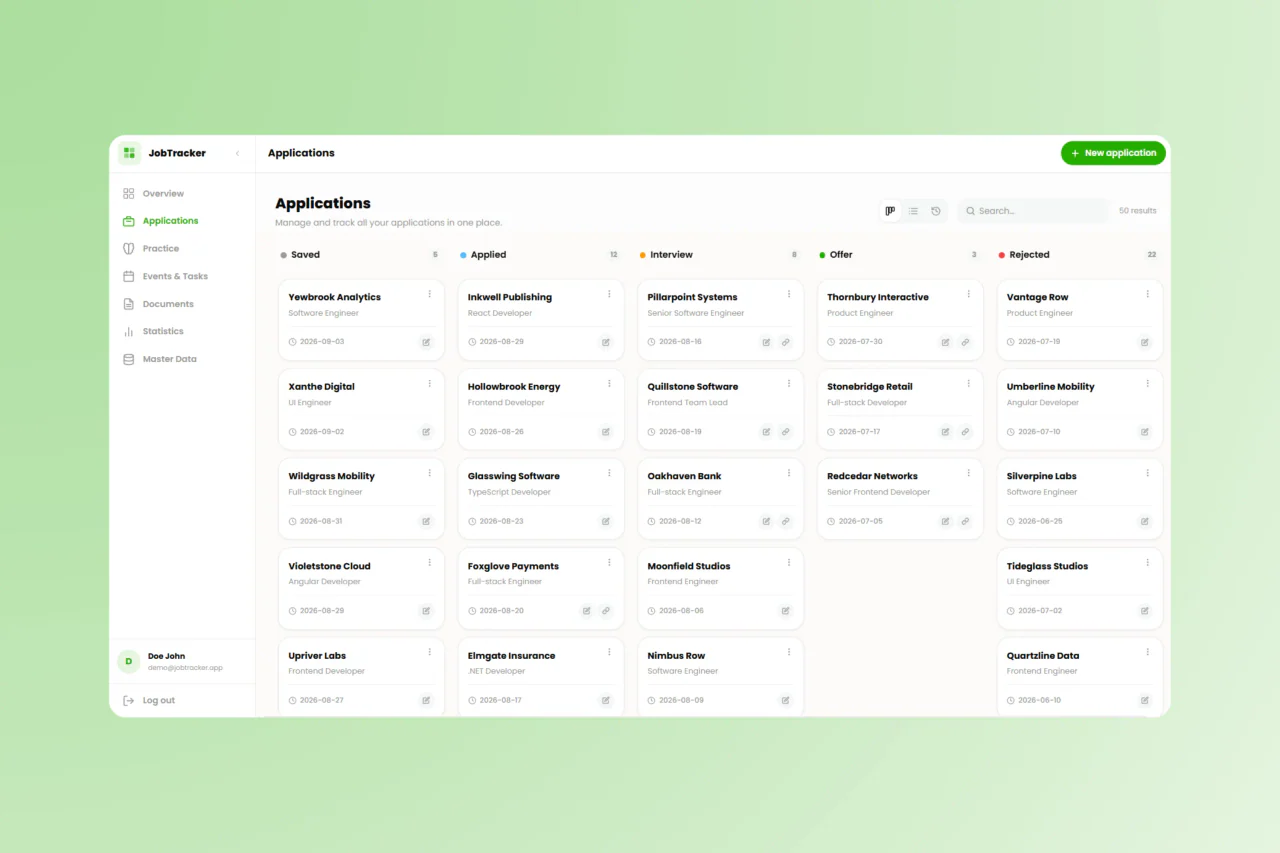
Track applications by company, role and stage, with notes, contacts and follow-up reminders, and a dashboard of active, pending and completed applications.
Documents
Upload CVs, cover letters and supporting documents, attach specific versions to individual applications, and keep one library across all positions.
AI interview practice
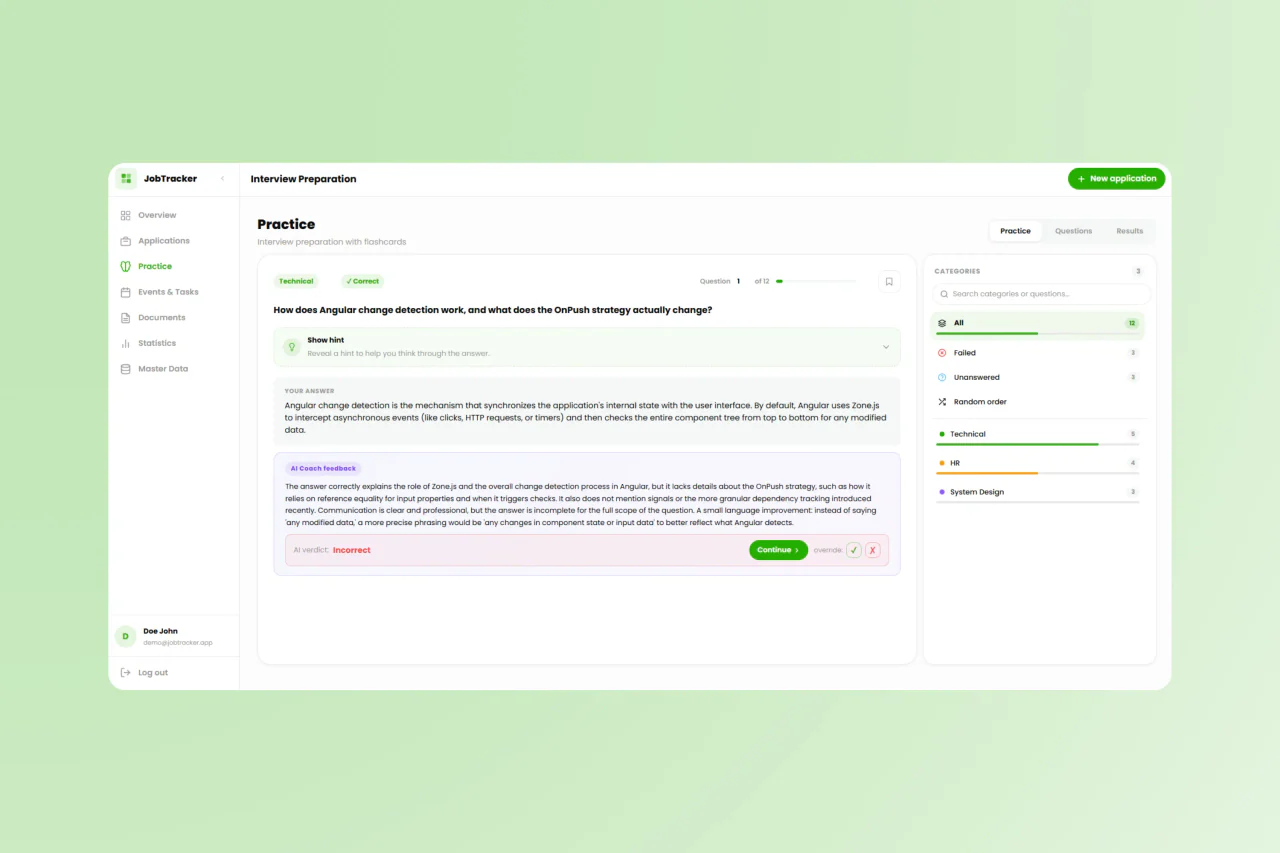
Answer role-relevant questions in structured sessions and get feedback from Azure AI Foundry on clarity and depth, with a history to follow progress.
Architecture
A layered ASP.NET Core system, deployed entirely on Azure.
The ASP.NET Core backend exposes REST endpoints for applications, documents and practice sessions. Entity Framework Core handles data access against Azure SQL, with code-first migrations managing the schema.
The app runs on Azure App Service. Documents live in Azure Blob Storage and are only reachable through short-lived, server-generated URLs, so the containers are never public. Answers are evaluated by Azure AI Foundry inside the same Azure environment.
Engineering decisions
Entity Framework Core
Code-first migrations allow fast schema iteration while keeping clean domain models and LINQ queries across the service layer.
Files outside the database
Blob Storage avoids the size and performance cost of storing files in SQL. Access goes through time-limited URLs generated by the backend.
Delegated identity
OAuth providers verify identity instead of a custom credential store, and every API call is authorized per user, so candidates only ever see their own data.
My role
A personal project that I designed and developed end to end, from the data model and API to the Angular interface and the Azure deployment.
Technologies
- Angular
- TypeScript
- ASP.NET Core
- C#
- Entity Framework Core
- Azure SQL
- Azure Blob Storage
- Azure AI Foundry
- Azure App Service
- OAuth 2.0
- GSAP